Article: Linocuts: A History
Linocuts: A History
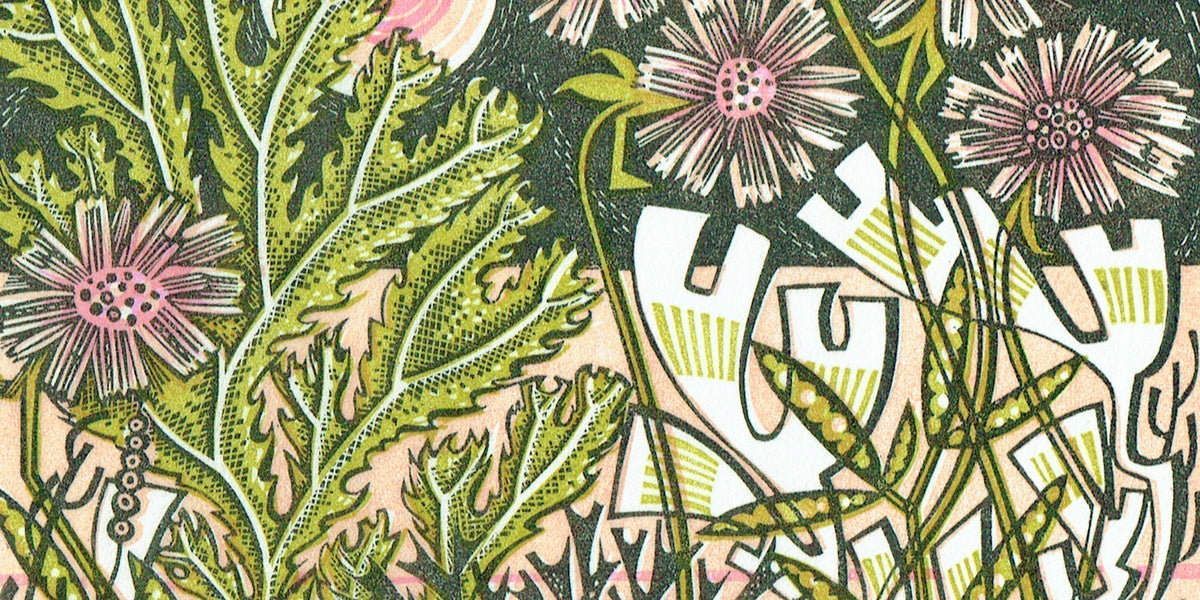
Since studying at the Central School of Art and Design, where I specialised in relief printmaking, I've continued to make linocuts. For many years I've also combined this with wood engraving: layering the fine detail of engraving into end-grain woodblocks with the more vigorous marks made by cutting into hessian-backed linoleum with U- and V-gouges celebrates the qualities of both.
I'm delighted that one of these prints, Sea Pinks, features on the cover of Linocuts: A History by Ella Ravilious and Gill Saunders, published by Thames & Hudson and the V&A and designed by Grade Design. The book explores the origins of linocut and the pioneering artists who transformed it, from Claude Flight, Sybil Andrews and Edward Bawden to Leopoldo Méndez, Tayo Quaye and Grayson Perry. It's beautifully illustrated, largely from the V&A's own print collection.
Linocut, like wood engraving, is a form of relief printmaking: areas of the linoleum are cut away and ink is rolled on to the raised surface that remains. I either hand-burnish using my wooden spoon or use a press on to fine Japanese papers, printing with oil-based inks in transparent colours, often with a more detailed graphic block in a stronger colour.
I've added Linocuts: A History to my bookshop, hosted by Bookshop.org, an online bookstore with a specific mission to financially support local, independent bookshops.