Article: In Praise of Ravilious
In Praise of Ravilious
I first wrote about my Ravilious ceramics a few years ago, and they're still very much part of daily life at home and in the studio – so it felt a fitting place to begin this journal.
It was finding an Eric Ravilious 1937 coronation mug that started my collection of his designs for Wedgwood. Both he and Edward Bawden, whose work I discovered just days after leaving Central School of Art and Design, had become important influences on how I approached my own work. While studying fine art printmaking at college, I took on my first illustration commission and enjoyed working on this collaborative project alongside creating my own prints and drawings. The work of Ravilious and Bawden was hugely exciting to me, as their personal and commercial pieces seemed so seamlessly intertwined, and every illustration or design for ceramics or wallpaper was so recognisably their own.

It was the inventive way they approached their illustration and design work that gave me such pleasure. I came to realise that a significant reason for this was that, as artist-printmakers in the pre-digital age, they also understood how commercial print worked. They physically cut lino blocks, engraved woodblocks and drew on lithographic stones – and these skills were invaluable in creating artwork that exploited the potential of the print process with great imagination and assurance. Their ability to explore the possibilities of working in one or two colours by contrasting black line with areas of white line out of black, balancing different weights of line and creating interesting tones through a variety of engraved and drawn textures (an integral part of lino cutting and wood engraving), resulted in bold, graphic work.
For me, the designs that Ravilious created for Wedgwood are a perfect example of collaboration between an artist and industry. His original artwork was subsequently engraved onto copperplate by skilled craftspeople at Wedgwood to create the paper transfers, which would be fired onto the china. The motifs and borders applied to plates, mugs and coffee pots retain the subtle tone and fine line of his wood-engraved vignettes and lithographs. The looping border of his 'Persephone' design and the twist motif created for 'Garden', each laid on a softly shaded band of colour, are unmistakably Ravilious. His original design drawings, sometimes incorporating collaged wood-engraved motifs and with areas cut away or patched over, reveal his thought processes.
The artist's 1937 coronation mug, with its frieze of fireworks, which Ravilious loved, above his signature lively lettering and numerals, immediately caught my eye in a Norfolk shop. The textured treatment of the royal coat of arms laid across a clear band of blue, with splashes of soft yellow behind the showers of fiery sparks, makes it a joyful object. I gradually added to my collection over the years: first, a few 'Persephone' plates, followed by a shallow soup bowl and then the coffee pot and cups. One Christmas morning, I unwrapped his blue striped 'Alphabet' mug, the lettering pairing perfectly with the illustrations. Each tiny vignette is eccentrically engaging and self-contained, including Y and Z (for yacht and zeppelin), waiting to be found inside the mug.

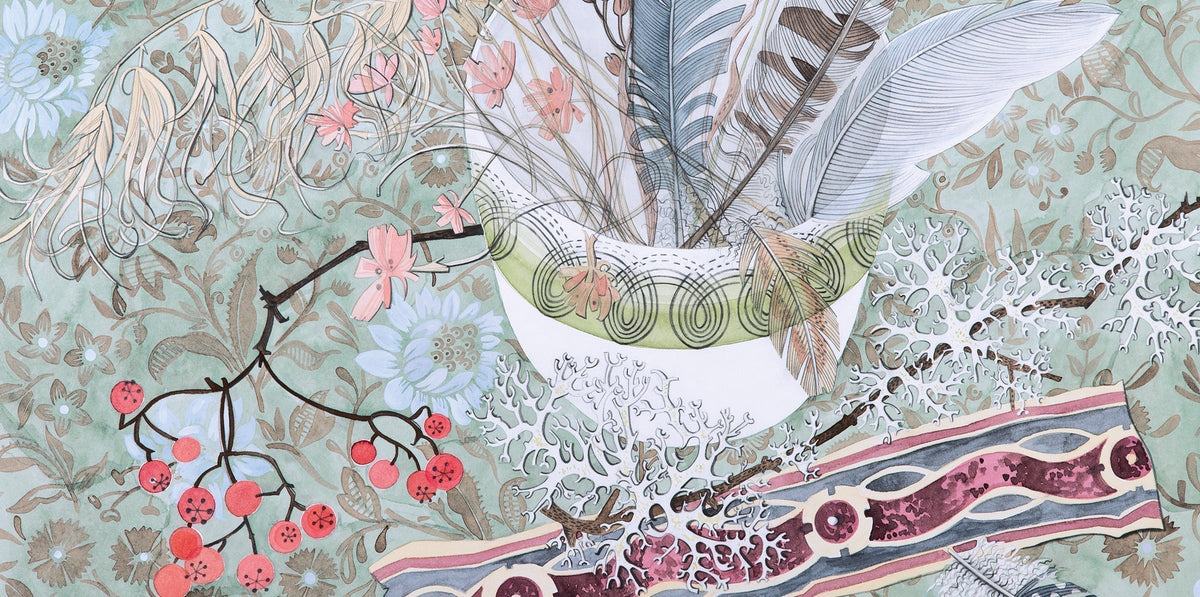
My Ravilious pieces sit in a collection of ceramics of all types and in varying conditions, some very chipped and cracked. Stuffed with seed heads and feathers – initially a haphazard form of storage for things I'd collected on walks and sketching trips – these ceramics gradually found their way into my still-life compositions. Often, the surface-pattern decoration flows off the jug or cup into the background to mingle with the real specimens gathered within.
Their inclusion references how important Ravilious' work is to me, but it may also owe something to an early visit to Cambridge that had a life-changing influence. While still at school in the early 1980s, I was wandering around the city with a friend when I happened to pass by Kettle's Yard. On a whim, we decided to ring the doorbell, with no idea what might be inside. Discovering Jim Ede's home, where art, domestic objects, books, plants and natural objects were displayed together, was a revelation for us both. Everything was clearly chosen and placed with great care and consideration, but it also seemed so simply and instinctively right. Here, a seed head or pebble is given the same prominence as a Ben Nicholson relief or a Henri Gaudier-Brzeska sculpture.
Although many of my Ravilious ceramics are now safely out of harm's way, most were designed for daily use. Drinking from a beautifully crafted cup or mug adds to the enjoyment of the everyday – and I'll always be uplifted by a meal eaten from a 'Persephone' plate.
A version of this piece first appeared in Inigo's Almanac in 2022.
My own works featured here, from top to bottom:
Persephone Bowl with Thrift and Feathers (watercolour)
Mug with Feathers (wood engraving)
Spey Larch and Feathers (screenprint)
Ravilious, Seedheads and Feathers (watercolour)